By Anna Katharina Finsler, Managing Director, Finsler Customs GmbH · Last updated:
Car import in seven steps: the import process at a glance
Importing from Germany takes seven steps: cost estimate in the import calculator, offer, binding order in your customer account, purchase (by you, or by us on your behalf), transport to the border, customs clearance (4 % vehicle tax, 8.1 % import VAT) and registration in your canton, mostly with an MFK. Allow 2–4 weeks, more with long MFK waits.
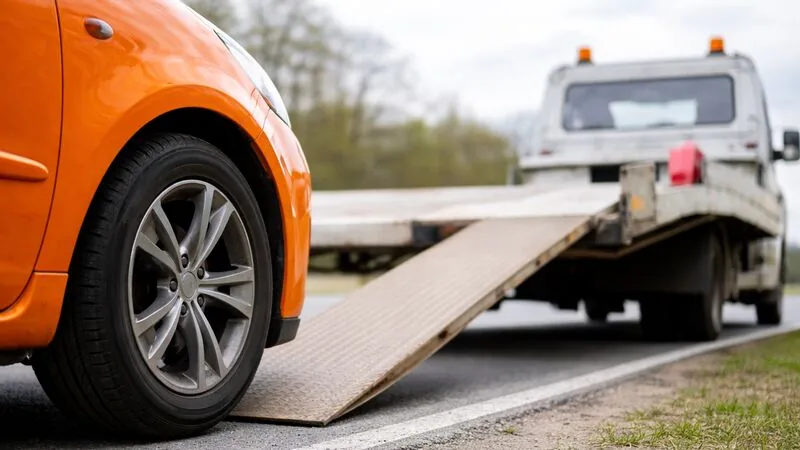
The seven steps
| Step | Who | Typical duration |
|---|---|---|
| Choose vehicle and check feasibility | You and us | 1–5 days |
| Offer (valid 7 days), binding order in the customer account, our acceptance | You and us | 1 day |
| Purchase (by you, or by us on your behalf) and document procurement | You or us | 2–5 days |
| Export declaration and transport | Us | 3–10 days |
| Customs clearance at Thayngen | Us and the customs office | usually same day |
| Roadworthiness test | Cantonal office | 1–8 weeks depending on the canton |
| Registration and handover | Cantonal office and us | 1–3 days |
What slows it down
Three things account for almost every delay: a missing COC certificate, a seller who does not deregister the vehicle in time, and a busy cantonal inspection office. We check the first two before the purchase contract; the third depends on where you live.
What has to be settled before you buy
Three things decide several thousand francs, and all three are settled before the deposit, not after.
First: can the VAT be shown on the invoice? In Germany a great many used cars are sold under the margin scheme of § 25a UStG. No VAT appears on the invoice there, so there is nothing to reclaim. On a EUR 30,000 car that is a difference of around EUR 4,790. On mobile.de you spot it by the filter “Mehrwertsteuer ausweisbar”; if in doubt, ask the dealer explicitly. It is the single most profitable question of the whole purchase.
Second: is there a COC? The Certificate of Conformity is the manufacturer's declaration of conformity. With a COC, Swiss registration runs on the existing type approval. Without one an individual approval is needed — that costs time and money, and for vehicles without European type approval it can fail outright. If the document is missing we order it from the manufacturer; depending on the make that takes one to four weeks.
Third: does the vehicle still count as new under customs law? That decides whether the CO₂ penalty applies. A vehicle is new if first registration was no more than six months ago — or six to twelve months ago with fewer than 5,000 km (CO₂ Ordinance SR 641.711 Art. 17d para. 3). Every gram above the individual target currently costs CHF 95. On a car at 160 g/km that quickly runs to several thousand francs. Anyone who knows the threshold sometimes deliberately buys the car that is two months older.
Export in the country of origin
Before the Swiss import comes the export from the EU country. It is the reason the foreign VAT comes back at all: the seller may supply free of tax as soon as the proof of export is in hand. Without a clean export declaration the invoice keeps its VAT — and the money stays with the seller.
The export declaration is handled by the seller or a service provider in their country. We prepare the paperwork so the dealer only has to sign; experience says this is the point where a private seller drops out and a dealer carries on as routine.
Export plates are only needed if you drive it yourself. You then need a German export plate (registration office fee about EUR 30–40, plates about EUR 20–40) with third-party liability insurance (about EUR 80–90 for 15 days, about EUR 90–110 for a month); German vehicle tax is due for at least one month. If we collect the car, both fall away: we move it on German dealer plates with insurance or on a trailer.
At the border: what is actually due
Import duty: CHF 0.00. With the abolition of industrial tariffs on 1 January 2024 the duty rate for vehicles is zero, whatever the country of origin. No proof of preferential origin (EUR.1) is needed for it. The often-quoted weight duty of CHF 12 to 15 per 100 kg no longer exists. The customs declaration itself nevertheless remains mandatory.
Automobile tax: 4 % — but not on every vehicle. Art. 2 para. 1 of the Automobile Tax Act lists exhaustively: passenger cars of tariff numbers 8703, vehicles of number 8702 up to 1,600 kg unit weight, and goods vehicles of number 8704 up to 1,600 kg. Motorcycles (8711) and caravans do not appear in that list — for them the 4 % falls away entirely. On a machine at EUR 15,000 that is around CHF 560 which other calculators wrongly include.
Import VAT: 8.1 % on the vehicle value plus all incidental costs up to the border plus the automobile tax. That transport costs belong in the tax base is set out in Art. 54 para. 3 lit. b VAT Act and is frequently overlooked — leaving them out understates the import VAT and produces a correction at the border.
Form 13.20 A: CHF 20 — CHF 5 through us. This is the customs document for motor vehicles, without which no Swiss registration is possible. The FOCBS Fees Ordinance (SR 631.035) charges CHF 20 when the customs office issues and certifies it during clearance (item 9.12), and CHF 5 when the person liable to declare affixes the Stammnummer themselves (item 9.22) — that is how we file.
After the border: reference number, insurance, MFK
Form 13.20 A creates the reference number (Stammnummer) — the identifier under which the vehicle is held in Switzerland. It is the precondition for everything that follows, because without it no insurer will issue a certificate.
Next comes the electronic insurance certificate (eVN). The insurer sends it straight to the road traffic office; it is valid for 30 days. Not every canton retrieves it online — in Bern, for instance, you have to telephone the road traffic and shipping office. Anyone who has the eVN issued too early and then waits for an MFK slot has to provide it a second time.
The MFK is the cantonal roadworthiness inspection. It checks technical condition and conformity with Swiss rules. The most common reasons for failure on imported vehicles are retrofitted lighting, modified exhaust systems and missing evidence for add-on parts. Passenger cars registered abroad for no more than a year and with no more than 2,000 km have been registered without an MFK since 1 January 2026 — the inspection then falls away entirely.
Finally the registration at the road traffic office of the canton of residence. After that the vehicle runs on Swiss plates.
How long the whole thing takes
Two to four weeks from the decision to buy to Swiss plates is the normal case. The spread almost never comes from the customs clearance — at our customs office in Thayngen that usually takes half a day — but from two other places.
A missing COC is the most common delay. Ordering it from the manufacturer takes one to four weeks depending on the make. That is why we ask about it before the purchase and not after clearance.
The MFK appointment is the second. Waiting times differ considerably from canton to canton. The Stammnummer is available as soon as the vehicle is cleared; we prepare the insurance certificate so that it can follow straight away.
Special case, relocation: free of charges, but with conditions
Anyone moving their residence to Switzerland can import their vehicle as relocation goods free of charges: automobile tax and import VAT fall away. The conditions are in Art. 14 of the Customs Ordinance — and they are regularly reported wrongly.
What is required is that you have used the vehicle for at least six months and will continue to use it in Switzerland. Use is what counts, not ownership — a leased vehicle can meet the condition just as well. The FOCBS names no fixed holding period after import; but anyone selling the car immediately afterwards does not meet the continued-use condition.
The CO₂ penalty is not covered by the exemption. It rests on the CO₂ Act, not on customs law, so on a young vehicle it remains payable even on relocation. This is the point where most online calculators come out too low.
Frequently asked questions
Do I have to travel to Germany in person?
No. In the Komfort and Premium packages we collect the vehicle from the seller and bring it to Switzerland; you see it for the first time at handover. As a rule you buy the car yourself. If you instruct us to, we also handle the purchase on your behalf and for your account.
Can I be there when the car is cleared at the border?
Yes, you are welcome to. Our office is about a kilometre from the Thayngen border crossing. Customers who import the car themselves and book only the customs clearance (Basic package) are usually there anyway, because they bring the vehicle to the border.
What happens if the vehicle fails the MFK test?
The faults found are put right and the vehicle is presented again. With the Premium package we prepare the vehicle for the test beforehand, so a failure is the exception. The MFK fee in the offer covers one inspection attempt; you bear the cost of the repair and the re-inspection, and Finsler Customs is not liable for a failed MFK.
Sources and legal basis
The statements on this page rest on the following official publications. The wording of the enactments in force is always decisive.
- FOCBS – Importing vehicles into Switzerland
- FOCBS – Customs declaration and taxes on a vehicle import
- Automobile Tax Act (AStG, SR 641.51) (German text)
- Federal Act on Value Added Tax (VAT Act, SR 641.20)
Company
Services
- All services
- Vehicle import DE→CH
- Customs clearance
- Vehicle sourcing
- Document service
- Import advice
- Vehicle detailing
Calculators and tools
- Import calculator
- Swiss customs fees
- CO₂ calculator
- CO₂ penalty
- Transport calculator
- Car transport to CH
- Check the Stammnummer
- FlexiMoto.ch
Location
Import by country of origin
- Importing a car from Germany into Switzerland
- Importing a car from Austria into Switzerland
- Import a car from France into Switzerland
- Import a car from Italy to Switzerland
- Import a car from the Netherlands into Switzerland
- Import a car from Belgium to Switzerland
- Importing a car from Luxembourg into Switzerland
- Importing a car from Czechia into Switzerland
- Importing a car from Poland into Switzerland
- Import a car from Sweden into Switzerland
- Import a car from Norway to Switzerland
Import by vehicle type
- Importing a passenger car into Switzerland
- Importing a motorcycle into Switzerland
- Importing a van up to 3.5 t into Switzerland
- Importing a motorhome into Switzerland
- Importing a caravan into Switzerland