By Anna Katharina Finsler, Managing Director, Finsler Customs GmbH · Last updated:
Is importing a car worth it?
Importing from Germany pays above all on cars from about CHF 15,000, on premium brands and on new cars with German VAT shown on the invoice. Two of our orders came in about CHF 14,140 (Mercedes GLS) and CHF 9,120 (BMW X5) below a comparable Swiss listing. On cheap small cars and margin-scheme vehicles the advantage is often too small.
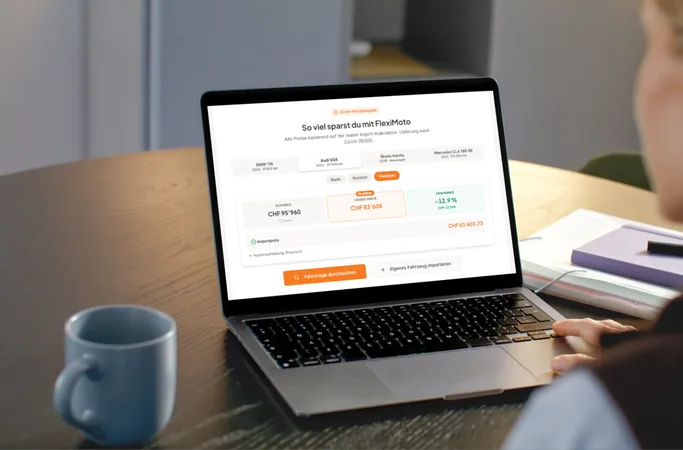
Why are cars cheaper in Germany?
List prices are often 10–30 % lower, because the German market is larger and more than 40,000 dealers compete for buyers. On top of that, the 19 % German VAT comes back when a car sold under the standard VAT scheme is exported; Switzerland then charges 8.1 % import VAT and 4 % automobile tax.
- A far bigger market — around 6.5 million cars changed hands in Germany in 2025 (KBA annual figures) — which means more competition and lower prices.
- Bigger discounts on new and nearly new cars: staff sales, fleet deals and day registrations.
- The VAT refund. On a dealer car under standard taxation the German VAT comes back — arithmetically 19/119 of the gross price — while Switzerland charges only 8.1 %.
- More equipment for the same money.
When does importing pay – and when not?
Usually from a vehicle value of around CHF 15,000, for used cars without a CO₂ penalty and for dealer purchases with VAT shown on the invoice. It gets tight with new cars from about 200 g/km CO₂, where the penalty can eat up the saving, and with private purchases without VAT. The import calculator works out your own case.
- Vehicle value from about CHF 15,000. The fixed costs — transport, customs declaration, MFK (Motorfahrzeugkontrolle, the Swiss roadworthiness test), together roughly CHF 900–1,300 — then weigh far less in percentage terms.
- The premium segment. BMW, Audi, Mercedes, Porsche and Volvo show the largest price differences, often 15 to 25 %.
- VAT that can be shown. New cars and dealer vehicles invoiced net.
- Electric cars. No CO₂ penalty at 0 g/km, and a large choice in Germany.
When you are better off buying in Switzerland
- Cheap small cars under CHF 10,000 — the import costs eat the price advantage.
- Margin-scheme vehicles without a clear discount to compensate.
- Very young models carrying a high CO₂ penalty — strong petrol engines without hybridisation, where the penalty only hits cars that count as new under customs law — if the price advantage is small.
A worked example
An Audi Q5 40 TDI, two years old: Swiss market price CHF 52,000. German dealer price EUR 45,000 net, about CHF 42,400 (calculated at EUR/CHF 0.94191, FOCBS daily rate of 15 October 2026). Total import costs around CHF 6,500 — vehicle tax, VAT, customs, transport, MFK and handling. Final price: about CHF 48,900 plus servicing, a saving of roughly 5 to 8 % in this example; on models with a wider price gap, correspondingly more. Your own figures come out of the car import calculator.
Break-even by price bracket
| Vehicle value | Share taken by fixed costs | Verdict |
|---|---|---|
| under CHF 10,000 | over 9 % | rarely worth it — the fixed costs eat the price advantage |
| CHF 15,000–25,000 | about 4–9 % | worth it where the VAT can be shown and the car is well equipped |
| CHF 25,000–50,000 | about 2–5 % | the core range — most imports happen here |
| over CHF 50,000 | under 3 % | the largest saving potential, particularly in the premium segment |
Fixed costs means transport, customs declaration and the MFK — together roughly CHF 900–1,300, and they fall due whatever the car is worth. The value-based charges (4 % vehicle tax, 8.1 % VAT) do not shift the ratio, because they stay the same in percentage terms.
One of our sample projects: BMW iX1
In our sample calculation, a young BMW iX1 20 eDrive M Sport (04/2025, 7,950 km) comes to CHF 40,527.66, ready to drive and registered; comparable Swiss offers are around CHF 3,770 higher. Being electric, it pays no CO₂ penalty. This and other sample projects with the full figures are on the references page.
Is an imported car worth less when you sell it on?
Once it has passed the MFK and been registered, an imported vehicle holds full Swiss papers — a registration document with its Stammnummer, the reference number under which the car is held in Switzerland — and the Europe-wide factory warranty. Technically and legally there is no difference from a car bought in Switzerland. What decides the resale value is what always decides it: condition, history and equipment. Anyone who hands over the service book and an unbroken chain of documents sells an imported car without a discount.
Frequently asked questions
Is it worth importing a cheap used car under CHF 10,000?
Usually not. Transport, customs declaration and the MFK cost a fixed sum of roughly CHF 900–1,300. On a CHF 8,000 car that is a surcharge of more than 10 % before any duties, and the lower German purchase price rarely makes that up.
Why are the savings biggest on premium brands?
The German market is considerably larger and more competitive for BMW, Audi, Mercedes, Porsche and Volvo, and on top of that come higher dealer discounts and day registrations. Price differences of 15 to 25 % are realistic in that segment.
How reliable is the “13 to 15 % import costs” rule of thumb?
It holds for cars from CHF 55,000 where the VAT can be shown, there is no CO₂ penalty and the car comes from southern Germany. For cheaper cars the share is higher, because transport and clearance are fixed amounts. It is also higher for powerful petrol cars that count as new under customs law (CO₂ penalty) and for longer transport distances, from northern Germany for example. It is lower for relocation goods, which are free of charges when you move. The exact figures come from the guide to calculating import costs.
In short
The more expensive, the younger and the better equipped the car, the more likely the import is to pay. A free import consultation with a concrete cost calculation settles the question for your model in fifteen minutes.
Sources and legal basis
The statements on this page rest on the following official publications. The wording of the enactments in force is always decisive.
- FOCBS – Importing vehicles into Switzerland
- FOCBS – Customs declaration and taxes on a vehicle import
- Automobile Tax Act (AStG, SR 641.51) (German text)
- Federal Act on Value Added Tax (VAT Act, SR 641.20)
Company
Services
- All services
- Vehicle import DE→CH
- Customs clearance
- Vehicle sourcing
- Document service
- Import advice
- Vehicle detailing
Calculators and tools
- Import calculator
- Swiss customs fees
- CO₂ calculator
- CO₂ penalty
- Transport calculator
- Car transport to CH
- Check the Stammnummer
- FlexiMoto.ch
Location
Import by country of origin
- Importing a car from Germany into Switzerland
- Importing a car from Austria into Switzerland
- Import a car from France into Switzerland
- Import a car from Italy to Switzerland
- Import a car from the Netherlands into Switzerland
- Import a car from Belgium to Switzerland
- Importing a car from Luxembourg into Switzerland
- Importing a car from Czechia into Switzerland
- Importing a car from Poland into Switzerland
- Import a car from Sweden into Switzerland
- Import a car from Norway to Switzerland
Import by vehicle type
- Importing a passenger car into Switzerland
- Importing a motorcycle into Switzerland
- Importing a van up to 3.5 t into Switzerland
- Importing a motorhome into Switzerland
- Importing a caravan into Switzerland