By Anna Katharina Finsler, Managing Director, Finsler Customs GmbH · Last updated:
Calculating import costs
Duties are 4 % vehicle tax on the customs value, 8.1 % import VAT on value plus tax, CHF 20 for report 13.20 A and possibly the CO₂ penalty on recent cars; no customs duty. Plus transport, clearance (Basic, CHF 350 incl. VAT) and the MFK. From CHF 55,000, about 13–15 % of the net price; more for cheaper cars.
How the figures build up
The basis is the customs value: the net purchase price converted at the customs exchange rate, plus every incidental cost up to the border. The vehicle tax of 4 % is calculated on that. Import VAT of 8.1 % is then calculated on the customs value plus the vehicle tax — the two cascade, which is why the effective rate is 8.424 % of the assessment base.
The common mistakes
- Forgetting transport in the base. Incidental costs up to the border belong in the assessment base of both charges.
- Counting on a VAT refund that never comes. Under a margin scheme there is nothing to reclaim.
- Assuming a customs duty. The old rule of thumb of CHF 12–15 per 100 kg disappeared on 1 January 2024.
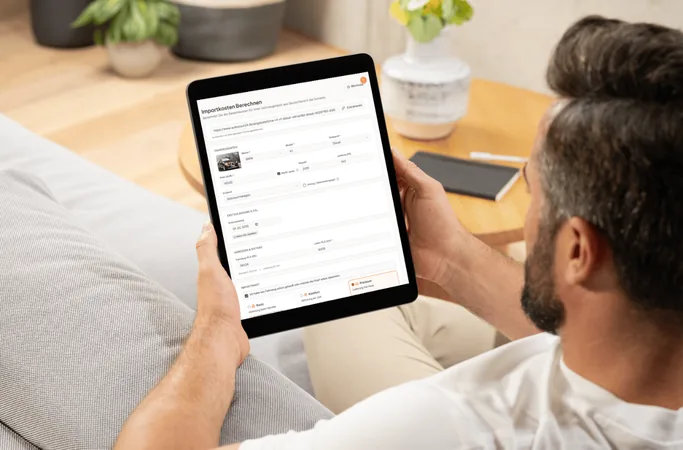
The import calculator does all of this for your specific vehicle, including the transport cost from the actual pick-up address.
Which exchange rate applies — and from when
For customs clearance it is not your bank's rate and not the rate a search engine shows that counts, but the FOCBS customs exchange rate. It is fixed on each trading day and applies to the following day.
What matters is the rate that applies on the day of clearance, i.e. the one published the day before, not the rate on the day of the purchase contract. One to three weeks often pass between deposit and border — on EUR 30,000, two centimes of rate difference move around CHF 600.
That is precisely why every quotation carries its date. In the Komfort and Premium packages the official customs exchange rate of that day applies; we do not charge for exchange-rate fluctuations. The exception is the purchase price where we buy the vehicle on your behalf: we settle it at the rate actually paid, in either direction. The Basic package has no exchange-rate protection. The duties themselves apply in every package as the FOCBS assesses them on the day of clearance. The rate in the calculator is updated daily from the official source.
If you compare with another calculator, first check which rate it uses and when it was last updated. A frozen rate is the commonest reason two calculators produce different totals for the same vehicle.
The four places where almost everyone miscalculates
First: transport costs belong in the tax base. Import VAT is levied not only on the vehicle value but on the value plus all incidental costs up to the Swiss border. That is Art. 54 para. 3 lit. b of the VAT Act. Leaving out the transport understates the figure and produces a correction at the border.
Second: the CO₂ penalty only hits vehicles new under customs law. A vehicle is new if first registration was no more than six months ago — or six to twelve months with fewer than 5,000 km. On a three-year-old used car it does not apply. Calculators that always include it show too high a price; ones that leave it out on a young vehicle show a far too low one.
Third: the automobile tax does not hit every vehicle. Art. 2 para. 1 of the Automobile Tax Act is an exhaustive list. Motorcycles of tariff number 8711 and caravans are not in it — for them the 4 % falls away. For vans of number 8704 the unit weight decides: taxable up to 1,600 kg, not above. It is the unit weight that counts, not the kerb weight from the registration document.
Fourth: what form 13.20 A costs depends on who files the declaration. The Annex to the FOCBS Fees Ordinance (SR 631.035) charges CHF 20 when the customs office issues and certifies the form during clearance (item 9.12), and CHF 5 when the person liable to declare affixes the Stammnummer themselves (item 9.22) — that is how we file.
What is in no formula yet still falls due
The duties are the largest item, but not the last. What comes after differs considerably by canton and vehicle — and is regularly overlooked when comparing quotations.
The MFK at the cantonal road traffic office: the official inspection fee, plus any rectification work. Passenger cars registered abroad for no more than a year and with no more than 2,000 km have been registered without an MFK since 1 January 2026 — that whole block then falls away.
Registration at the road traffic office of your canton of residence, with a fee that varies by canton.
A missing COC, if the manufacturer has to supply it. The amount is manageable; the one-to-four-week wait is the real price.
What does not fall due with us: refuelling at handover, checking an existing tow bar, and a mark-up on the exchange rate. Other providers list these separately in their calculator; with us they stand at CHF 0.00 from the Komfort package upwards. In every package, Basic included, the import charges run through our customs account without a mark-up. Swiss plate holders and the digital motorway vignette are included only in the Premium package, because they require the registration.
Frequently asked questions
When is each charge due?
Vehicle tax and import VAT are assessed on import at the border. Customs duty is assessed as well, but has been CHF 0 since 1 January 2024. Where an MFK test is required, you pay its fee to the road traffic office. The German VAT is refunded by the German dealer once the proof of export has reached them.
Can I reclaim the German VAT myself?
The refund runs through the German dealer: they pay back the 19 % once the stamped proof of export is available. Without a correct export declaration the claim lapses, which makes it the most expensive single mistake in a self-import.
In which currency do I pay the charges?
In Swiss francs. Vehicle tax, import VAT and any CO₂ penalty are assessed in francs on import; there is no import duty, the duty rate is zero. The road traffic office also bills the MFK fee in francs. The FOCBS converts the customs value at its exchange rate of the day before the customs declaration.
Sources and legal basis
The statements on this page rest on the following official publications. The wording of the enactments in force is always decisive.
- FOCBS – Importing vehicles into Switzerland
- FOCBS – Customs declaration and taxes on a vehicle import
- Automobile Tax Act (AStG, SR 641.51) (German text)
- Federal Act on Value Added Tax (VAT Act, SR 641.20)
- FTA – Value added tax
Company
Services
- All services
- Vehicle import DE→CH
- Customs clearance
- Vehicle sourcing
- Document service
- Import advice
- Vehicle detailing
Calculators and tools
- Import calculator
- Swiss customs fees
- CO₂ calculator
- CO₂ penalty
- Transport calculator
- Car transport to CH
- Check the Stammnummer
- FlexiMoto.ch
Location
Import by country of origin
- Importing a car from Germany into Switzerland
- Importing a car from Austria into Switzerland
- Import a car from France into Switzerland
- Import a car from Italy to Switzerland
- Import a car from the Netherlands into Switzerland
- Import a car from Belgium to Switzerland
- Importing a car from Luxembourg into Switzerland
- Importing a car from Czechia into Switzerland
- Importing a car from Poland into Switzerland
- Import a car from Sweden into Switzerland
- Import a car from Norway to Switzerland
Import by vehicle type
- Importing a passenger car into Switzerland
- Importing a motorcycle into Switzerland
- Importing a van up to 3.5 t into Switzerland
- Importing a motorhome into Switzerland
- Importing a caravan into Switzerland