By Anna Katharina Finsler, Managing Director, Finsler Customs GmbH · Last updated:
Roadworthiness test and registration after an import
Most imports must pass the MFK roadworthiness test in your canton of residence before registration; the wait is 1–8 weeks, depending on the canton. Since 1 January 2026, passenger cars registered abroad for at most one year and driven at most 2,000 km are registered without the test. Required: inspection report 13.20 A, the COC and electronic proof of insurance.
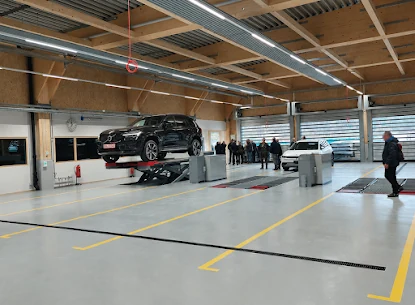
The sequence
- Customs clearance. Vehicle tax and import VAT are paid; you receive the assessment decision and the inspection report 13.20 A with the Swiss reference number.
- Insurance. Liability cover is mandatory; the electronic insurance certificate is issued on the reference number and is valid for 30 days.
- Inspection appointment. Booked with the cantonal road traffic office. Waiting times vary a lot between cantons.
- Registration. Number plates are issued and the vehicle licence is produced.
Registration without presentation since 1 January 2026
Since 1 January 2026, a passenger car also counts as new if it was registered abroad no more than a year ago and has covered no more than 2,000 km (Art. 29(5)(b) VTS). For new, complete passenger cars of category M1 an administrative check is then enough: the importer signs an inspection report based on the electronic individual vehicle data record (Art. 30(1)(b) VTS). The car does not have to go to the road traffic office; it is registered on paper. Its first periodic MFK is due five years after it was first put into service.
- Passenger car of category M1, complete and unmodified
- Registered abroad no more than a year ago, or never registered
- No more than 2,000 km on the clock
- An electronic individual vehicle data record exists (otherwise an inspection report signed by the type-approval holder)
That typically covers pre-registered cars, demonstrators and stock vehicles. Every other import — older than a year, over 2,000 km, vans, motorcycles, modified vehicles — is presented before registration. For vans and motorcycles the administrative route needs a report signed by the type-approval holder, which a single import rarely has. Legal basis: amendment to the VTS of 15 October 2025, AS 2025 646 (German text).
Typical costs
| Item | Amount |
|---|---|
| Roadworthiness test, passenger car | about CHF 60–160; without a COC CHF 240 in Bern and Geneva |
| Vehicle licence | CHF 20–85 |
| Pair of number plates | CHF 20–50 |
Cantonal fee schedules, as of September 2026.
If the vehicle fails
You receive a defect report with a deadline, usually 30 days. After the repair a re-inspection is needed; Bern and Schaffhausen charge from CHF 30 for it. The most frequent reasons are modified lights, non-original wheels and a retrofitted towbar — all of which we check before the appointment.
The documents to have ready
- The customs certificate (form 13.20 A) you receive at clearance
- The COC certificate (EU type approval)
- The German registration documents, parts I and II
- The inspection report (form 13.20 B)
- Electronic proof of insurance
- A copy of your ID and proof of residence
If the COC is missing, a data confirmation from the manufacturer or the general importer has to be obtained before the appointment, not on the day.
What the inspection actually covers
The MFK (Motorfahrzeugkontrolle) checks safety- and emissions-relevant components. How extensive it gets depends on your paperwork: if the COC is on hand, or FEDRO has issued a data sheet for the type, the technical data is documented and the office only checks that your vehicle matches it. If neither is available, every figure has to be proven separately — up to and including reports from a recognised test centre.
- Brakes and brake fluid
- Steering and suspension
- Tyres, tread depth at least 1.6 mm
- Lights and headlamps, including alignment
- Emissions, by exhaust test or OBD
- Seatbelts and airbags
Cars from countries that drive on the left bring two extra points: the speedometer must read km/h — a mph-only display is not accepted — and the headlamp asymmetry has to be changed. US imports often need a rear fog lamp retrofitted. For EU vehicles none of that applies.
Costs and waiting times by canton
Road traffic offices are run by the cantons, so prices and waiting times differ noticeably. For imported vehicles some offices only offer later appointments. A selection of six cantons:
| Canton | Test, passenger car | Vehicle licence + plates | Waiting time |
|---|---|---|---|
| Zurich (ZH) | CHF 30 per test unit | CHF 42 + 40 | 4–8 weeks |
| Bern (BE) | CHF 120, without COC 240 | CHF 85 + 45 | 3–6 weeks |
| Aargau (AG) | CHF 58 per 20-minute test unit | CHF 20 + 20 | 2–4 weeks |
| St. Gallen (SG) | CHF 60–160 | CHF 40 + 30 | 2–5 weeks |
| Schaffhausen (SH) | CHF 120; with COC and first registered under 3 months ago: 90 | CHF 45 + 5–50 | 1–4 weeks |
| Geneva (GE) | CHF 160, without COC 240 | CHF 55 + 30 | 4–6 weeks |
Fees from the cantonal fee schedules, as of September 2026, without guarantee. Zurich and Aargau charge per test unit; depending on the test, a vehicle needs several. The waiting times are our own experience. Insurance and road tax come on top.
Where it usually goes wrong
- A missing COC. Clear it up in advance, otherwise everything slips by weeks.
- Tyres or wrapping that do not meet Swiss rules. Put that right before the appointment.
- An expired German HU (Hauptuntersuchung). The German test never replaces the Swiss check.
Frequently asked questions
How long does the MFK take for an imported vehicle?
The inspection itself takes 45–90 minutes. The wait for an appointment runs from 1 to 8 weeks depending on the canton, with Zurich and Geneva usually the longest.
Do I have to do the MFK before or after registration?
Most imported vehicles are presented before their first Swiss registration. The exception since 1 January 2026: M1 passenger cars registered abroad for no more than a year and with no more than 2,000 km are registered on paper alone and need their first MFK only after five years. The vehicle licence is issued once the inspection has been passed or the administrative check completed. The Stammnummer, the Swiss reference number, already comes with the vehicle from customs — it is written on the 13.20 A report.
Does a fresh German TÜV certificate replace the MFK?
No. A German test never replaces the Swiss check, however recent it is. Whether the car has to be presented depends on its age and mileage: passenger cars registered abroad for no more than a year and with no more than 2,000 km have been registered without presentation since 2026, all others are inspected by the cantonal office. A current TÜV report is still useful because it documents the condition of the car.
Which documents do I need for the MFK after an import?
The customs certificate form 13.20 A from the clearance, the COC certificate (EU type approval), the German registration certificates part I and II, the electronic proof of insurance from your Swiss insurer, and a copy of your ID with proof of residence. If the COC is missing, a data confirmation from the manufacturer or the general importer has to be obtained before the appointment. Why the insurer needs the Stammnummer before it can send that proof is explained in the guide insurance for an imported car.
What does the MFK cost for an imported vehicle?
The test fee for a passenger car is about CHF 60–160 depending on the canton; without a COC, Bern and Geneva charge CHF 240. The vehicle licence and a pair of plates add CHF 40–130 together. Zurich and Aargau charge per test unit. Presenting the vehicle properly prepared avoids a re-inspection, which costs from CHF 30 in Bern and Schaffhausen.
Can I import an accident-damaged car or one with hail damage?
Yes, in principle any vehicle can be imported, though its condition can complicate registration. Import VAT is normally based on the price paid; if the stated value is doubtful, customs can estimate it, so attach damage photos or an assessor's report to the contract. Have the damage repaired before the MFK: only a car meeting Swiss rules is registered.
Sources: FOCBS – Customs declaration and taxes on a vehicle import · Road traffic office of Lucerne – Imported vehicles (German text)
With the Premium package we prepare the vehicle for the inspection, book the appointment and present the car — in all 26 cantons. The full sequence is set out in our import process guide.
Sources and legal basis
The statements on this page rest on the following official publications. The wording of the enactments in force is always decisive.
- FOCBS – Importing vehicles into Switzerland
- FOCBS – Customs declaration and taxes on a vehicle import
- Automobile Tax Act (AStG, SR 641.51) (German text)
- Federal Act on Value Added Tax (VAT Act, SR 641.20)
- Ordinance on the Licensing of Persons and Vehicles for Road Traffic (VZV, SR 741.51) (German text)
- asa – Association of the Swiss road traffic offices (German text)
Company
Services
- All services
- Vehicle import DE→CH
- Customs clearance
- Vehicle sourcing
- Document service
- Import advice
- Vehicle detailing
Calculators and tools
- Import calculator
- Swiss customs fees
- CO₂ calculator
- CO₂ penalty
- Transport calculator
- Car transport to CH
- Check the Stammnummer
- FlexiMoto.ch
Location
Import by country of origin
- Importing a car from Germany into Switzerland
- Importing a car from Austria into Switzerland
- Import a car from France into Switzerland
- Import a car from Italy to Switzerland
- Import a car from the Netherlands into Switzerland
- Import a car from Belgium to Switzerland
- Importing a car from Luxembourg into Switzerland
- Importing a car from Czechia into Switzerland
- Importing a car from Poland into Switzerland
- Import a car from Sweden into Switzerland
- Import a car from Norway to Switzerland
Import by vehicle type
- Importing a passenger car into Switzerland
- Importing a motorcycle into Switzerland
- Importing a van up to 3.5 t into Switzerland
- Importing a motorhome into Switzerland
- Importing a caravan into Switzerland